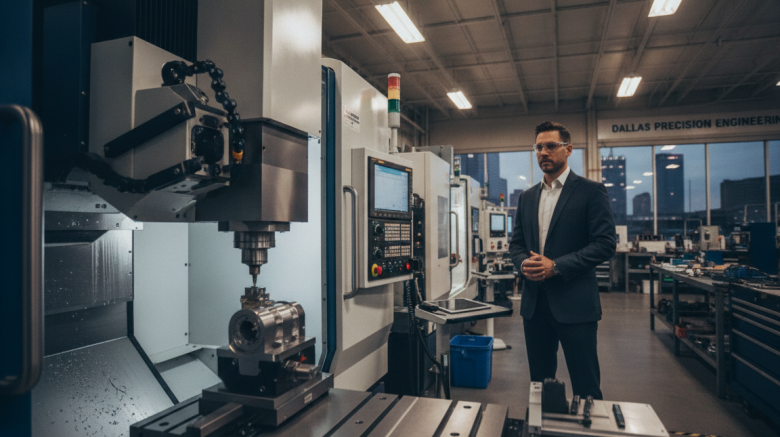
High-precision machining plays a vital role in aerospace, healthcare, and industrial production by delivering consistent dimensions and dependable component quality. Through CNC lathe machining in Dallas, suppliers can achieve close dimensional limits, uniform finishes, and reliable production output. Such precision lowers the frequency of rework, limits scrap, and minimizes costly production interruptions. Multi-technology machine shops combine multi-axis mills, CNC lathes, EDM equipment, waterjet cutters, and laser-processing systems. This combination enables intricate components to move through production with fewer setups, less repositioning, and reduced supplier handoffs. These efficiencies shorten machining cycles and improve quality for engine hardware, aircraft landing-gear parts, and electronic housings.
Local visibility has become an important part of building credibility and attracting work within the Dallas machining market. Machine shops use Instagram and other social-media channels to publish process photographs, equipment videos, completed-part examples, and case studies. The strategy generates customer interest and supports recruitment of experienced operators and technical personnel across the local CNC sector.
Real-world implementations such as Paramount Machine’s adoption of Datanomix demonstrate how Automated Production Intelligence can improve manufacturing visibility. Machine connectivity enables the system to expose real operating data, including spindle activity, downtime causes, and true utilization levels. Access to reliable production data allows Dallas machining providers to refine estimates, reduce cycle duration, increase equipment use, and strengthen margins.
The following case study examines machinery, materials, workflow changes, and commercial outcomes that can be applied in real operations. Attention is directed toward repeatable strategies that can be introduced by machining services in Dallas and throughout the broader regional manufacturing ecosystem.
Case Study Overview Of Dallas CNC Lathe Machining
This analysis explores the role of high-accuracy CNC turning within Dallas production environments. The discussion highlights why accurate turning is essential for applications involving complicated forms and stringent tolerances. Topics include choosing suitable turning equipment, managing process variables, handling materials correctly, selecting tooling, and implementing monitoring systems. Together, these methods strengthen quoting, increase productive machine time, and improve operational performance. Customer comments and visible project examples help validate performance while building confidence in the selected manufacturing partner.
Case Study Purpose And Coverage
The primary objective is to show how consistent, controlled processes reduce waste and accelerate the production of critical components. Covered areas include machining setups, inspection protocols, operational measurements, and methods for continuous process refinement. The study places particular emphasis on monitoring cycle duration, tool life, machine activity, and material traceability during prototype and production work.
Target Dallas Markets: Aerospace, Defense, Healthcare, Automotive, And Industry
Aerospace products such as engine components, landing-gear parts, and avionics housings frequently require micron-level dimensional accuracy. Defense-sector parts must combine robust construction with accountable materials, controlled production, and reliable inspection. Healthcare components rely on approved materials, carefully managed surface conditions, and highly accurate finishing. Automotive and industrial customers generally seek economical production, repeatable quality, and capacity for substantial order volumes.
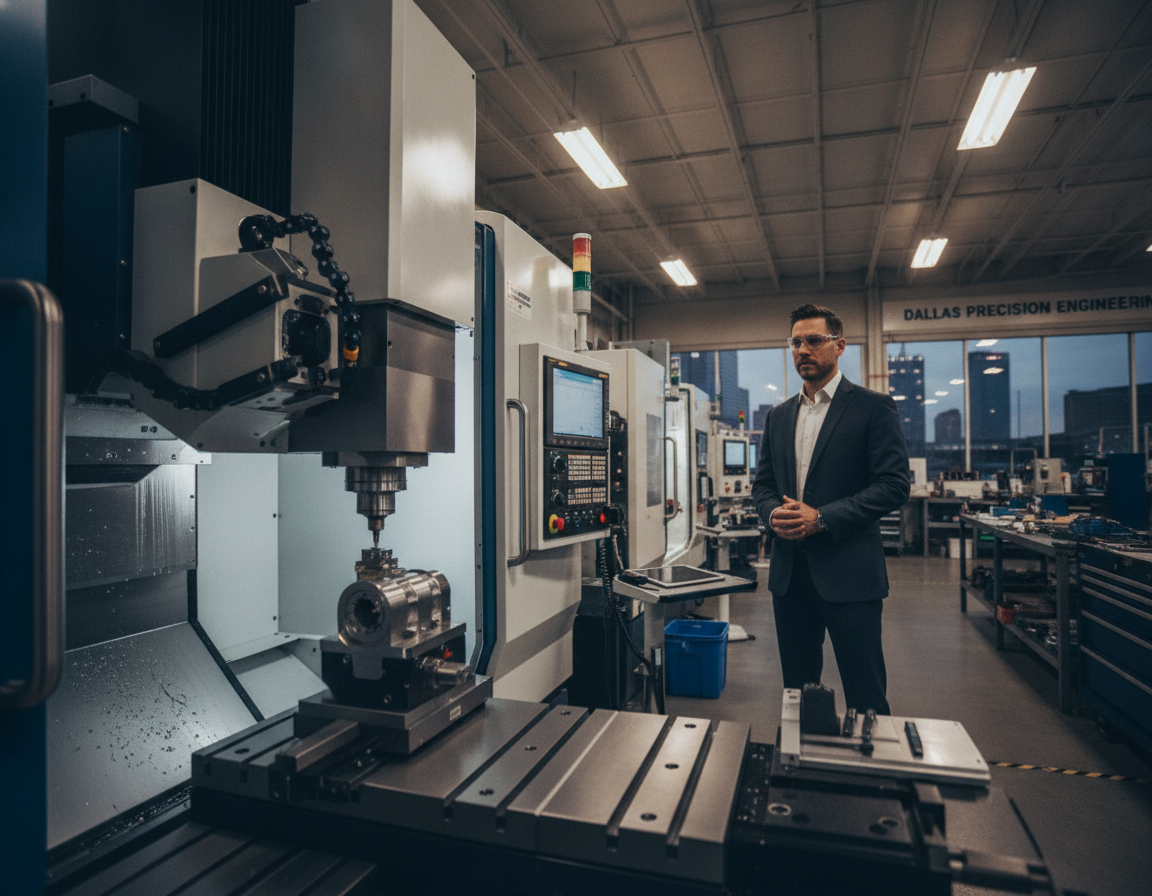 Custom Mold Services Dallas
Lowrance Machine Profile And Local CNC Machine Shop Services
Lowrance Machine combines Dallas CNC turning and milling with Datanomix production intelligence to strengthen machine utilization and operational reporting. Its services include multi-axis production, accurate CNC turning, specialized tooling, and adaptable processes covering short development runs through long-term manufacturing.
| Technical Resource | Primary Benefit | Relevance |
|---|---|---|
| Multi-axis milling | Reduced repositioning with improved handling of intricate shapes | Useful for aircraft enclosures and precision medical components |
| Accurate lathe-machining equipment | Reliable concentricity and smooth finishes across repeated production | Important for engine hardware and precision shaft production |
| Tooling for specialty fasteners | Reliable manufacturing of nonstandard fastener forms and threaded features | Supports custom fasteners Dallas and specialized assembly requirements |
| Automated machine monitoring | Immediate visibility into running time, idle periods, and cycle trends | Supports stronger estimates and job costing for Dallas CNC shops |
| Quality inspection stations | Early error detection through sensors, vision equipment, and CMM inspection | Confirms compliance with aerospace and medical specifications |
| Scalable component-manufacturing workflows | Flexible quantities covering development parts through full production | Enables suppliers to expand production as customer demand increases |
Dallas Machine Shop Equipment And Technical Capabilities
Machine shops across Dallas combine modern milling and turning systems with experienced manual craftsmanship for challenging aviation and industrial projects. A mixture of automated precision equipment and manual experience allows providers to support prototypes, one-off repairs, and scheduled manufacturing runs. Live production intelligence enables planners to align machines with current demand and minimize unnecessary downtime.
Benefits Of 5-Axis Machining For Complex Dallas Components
Multi-axis platforms combine rotational and linear movement to reduce setup requirements for complicated aerospace components. Completing more work in a single setup lowers fixture requirements and improves finish consistency across freeform surfaces. Five-axis machining allows Dallas manufacturers to reduce operator handling and preserve alignment on precisely contoured components.
CNC Lathe Machining In Dallas: Equipment, Tooling, And Accuracy
Advanced CNC lathes with live tooling produce precision features in challenging materials including titanium and corrosion-resistant steel. Common workholding and cutting systems include accurate collets, hydraulically operated chucks, and indexable tooling designed for sustained production. Maintaining aerospace-grade dimensions requires stable machine frames, temperature correction, dependable fixturing, and systematic monitoring of tool condition.
Integrating CNC Milling And Manual Machining In Dallas
CNC milling Dallas equipment efficiently produces detailed pockets, narrow profiles, and complex machined features. Traditional manual machining continues to support custom fixtures, single components, repair work, and small fitting corrections. Using CNC and manual processes together allows manufacturers to transition efficiently from prototype work to production without losing dimensional control. Integrating automated milling and manual expertise helps industrial machine shops complete custom or small-batch work more quickly.
Improving Machining Processes And Production Performance
Meaningful improvements in precision-machine shops often result from numerous carefully planned adjustments rather than a single major change. These refinements include optimizing tool setups, selecting suitable coolant formulations, improving fixture methods, and revising multi-axis programs. The objective is to shorten machining cycles without sacrificing tolerance control, surface quality, or process reliability. This approach increases throughput for machining services in Dallas and for specialized work performed within CNC machine shops.
Reducing cycle time depends heavily on minimizing setups and creating more efficient toolpaths. Dallas 5-axis teams apply adaptive feeds, controlled chip removal, and carefully sequenced operations to improve production. The result is less idle motion, fewer interruptions, and reduced operator intervention. By measuring spindle hours and downtime, planners can identify idle equipment and shift production accordingly.
Automated production intelligence provides immediate visibility into actual shop-floor performance. Real-time dashboards present true cycle rates, interruptions, downtime categories, and past job performance. This information supports competitive quotations, more accurate costing, and the identification of bottlenecks that reduce margins for machining services in Dallas.
Monitoring platforms help management identify repeated stoppages caused by coolant replacement, cutter wear, material shortages, or operator delays. Shops may introduce preventive tool swaps, more effective coolant strategies, and updated process controls to protect part quality. Performance information also helps managers decide whether a job should remain in-house or be transferred to another supplier.
Machine shops now integrate error-proofing technology directly into production to identify problems early. Machine-mounted vision equipment checks component presence, orientation, and basic features during first-article approval and recurring production. Laser profilers measure important diameters, edges, and contours before components move into secondary operations. Coordinate measuring machines provide final dimensional confirmation for selected production samples and completed lots.
Multiple levels of quality verification reduce rejected components and rework while supporting compliance with aviation and healthcare specifications. Strong process controls also reduce emergency repair demands and integrate with industrial machine repair Dallas planning when equipment problems arise.
Production information allows technicians to plan preventive servicing before small issues develop into major downtime. Automated alerts identify emerging concerns such as spindle instability, coolant-quality problems, and worsening machining performance. Early warnings allow Dallas industrial-equipment repair specialists to intervene before complete failure or permit specific parts to be replaced. The partnership between production data and maintenance planning reduces disruption and strengthens delivery reliability.
Specialty Components, Materials, And Dimensional Requirements
Local machine shops manufacture components from a wide range of aerospace-grade and industrial materials. Common raw stocks include 7075 and 6061 aluminum, Ti-6Al-4V titanium, alloy steels, stainless grades, and advanced composite laminates. Each stock type demands specific cutter geometry, machining speeds, fixture strategies, and cooling practices to control wear and temperature.
When cutting aluminum, shops favor polished and positive-rake tools capable of supporting fast material removal. For titanium work, manufacturers use lower chip loads, strong fixtures, and coated cutters designed to resist heat and wear. Composite machining relies on purpose-built cutting tools, vacuum workholding, and carefully managed parameters to prevent layer separation. Such tailored methods support consistent surface quality and dependable repetition during Dallas CNC turning operations.
Close-tolerance aircraft components depend on environmental stability, reliable workholding, and carefully validated machine setups. Advanced turning equipment maintains micron-scale accuracy through temperature correction, internal measurement, and regular verification. Quality protocols use CMM measurement, laser inspection, calibrated gauges, and SPC analysis to detect dimensional drift.
High-accuracy fixturing with multiple stations minimizes loading errors and supports consistent machining cycles. Industrial machining providers in Dallas feed measurement information back into production to identify changes before defective quantities accumulate. This strategy reduces rework while supporting reliable delivery of components used in safety-critical aircraft systems.
Dallas suppliers frequently manufacture specialty components such as custom fasteners, cast inserts, threaded sleeves, and mold inserts. Dallas custom-fastener suppliers integrate forming, CNC turning, threading, thermal processing, finishing, and measurement. Such manufacturing controls allow fasteners to meet demanding aerospace expectations for durability and documented conformity. Machined inserts require exact shoulders, threads, and press-fit dimensions for dependable use in aluminum or composite structures.
Mold inserts require polished surfaces, accurate flatness, and closely controlled dimensional relationships. Shops frequently combine CNC lathe machining Dallas for rotational details with CNC milling or EDM for cavities and noncircular geometry. Data-based quotations and utilization tracking help suppliers protect margins on specialty runs while maintaining competitive lead times.
| Typical Part | Representative Stock | Primary Manufacturing Steps | Target Tolerance |
|---|---|---|---|
| Engine shaft | Aerospace-grade Ti-6Al-4V | Precision turning, heat treatment, grinding, and CMM inspection | ±0.005 mm |
| Aircraft landing-gear bushing | Heat-treated 7075 aluminum | CNC machining, bore finishing, protective anodizing, and fit verification | Approximately ±0.02 mm |
| Aircraft electronics housing | Heat-treated 6061-T6 aluminum alloy | Machining, deburr operations, cleaning, and enclosure leak inspection | A general tolerance of ±0.05 mm |
| Made-to-order precision fastener | High-strength alloy steel | Heading, CNC turning, heat treatment, and coating | Approximately ±0.03 mm |
| Cast insert | Industrial bronze or corrosion-resistant steel | Final turning, thread creation, dimensional measurement, and press-fit testing | ±0.04 mm |
| Hardened mold component | Industrial H13 mold steel | EDM, CNC finishing, polishing, and CMM inspection | A precision tolerance of ±0.01 mm |
When designers and shop-floor specialists work together, projects progress more quickly with fewer costly changes. Lowrance Machine and comparable Dallas providers illustrate how integrated manufacturing capabilities can produce specialty components at meaningful scale. The integrated approach helps Dallas industrial machine shops remain commercially competitive without sacrificing aviation-grade precision.
How CNC Turning Supports Custom Molds And Precision Inserts
CNC turning forms an important foundation for mold-building and tooling work throughout the Dallas market. Precision lathe work and milling create the primary forms used for mold cavities, cores, rotational components, and tooling inserts. These processes maintain the dimensional relationships and surface conditions needed for consistent molding performance.
Capabilities And Workflow For Custom Mold Services In Dallas
Local mold providers use CAM programming and multi-axis machining to produce complex tooling geometries. Complex molds are produced through carefully planned tool motion, purpose-built fixtures, and controlled finishing operations. EDM equipment creates narrow features, internal corners, deep details, and other forms that conventional cutters cannot reach effectively.
Consistent mold quality requires appropriate tools, dependable workholding, standardized processes, and in-process measurement. The result is dependable cavity form and precise concentricity suitable for molds expected to complete substantial production volumes.
Producing Dallas Injection, Rubber, And Industrial Molds With CNC Machining
Dallas injection-mold projects depend on precise cavity forms, material-flow paths, gate locations, and sealing features. Precision lathe machining creates round mold components with controlled diameters, concentricity, and true-running surfaces. Rubber molds Dallas projects require suitable draft angles and smooth finishes to limit flashing, tearing, and post-molding trimming.
Dallas industrial-mold projects may require oversized tooling, heavy mold bases, and durable steel grades. Shops machine the main forms first and then apply grinding, surface finishing, polishing, or texture treatments to complete the tool.
How Dallas Mold Builders Use Precision Turning For Accurate Inserts
Dallas mold builders work closely with machining suppliers to ensure engineered designs can be produced accurately and economically. CNC lathes manufacture threaded inserts, core components, concentric bores, and stepped features that fit correctly within mold assemblies.
Mold builders use recorded performance and machine-activity data to organize runs, predict expenses, and plan equipment care. This coordination shortens project schedules and improves dimensional compatibility between molded components and subsequent assembly operations.
| Component | Typical Process Steps | Quality Check |
|---|---|---|
| Injection-mold cavity block | Three-axis roughing, five-axis finishing, and EDM detailing | CMM dimensional verification with surface-profile measurement |
| Core pin or sleeve | Precision turning followed by thermal processing and finish grinding | Diameter, runout, surface, and hardness verification |
| Mold insert for overmolding | Multi-axis milling, precision turning, and controlled polishing | Visual examination and dimensional sampling |
| Rubber mold template | Initial tooling build, CNC refinement, and specified texture treatment | Material-performance testing with size and form inspection |
| Large industrial mold plate | CNC plate production, feature machining, thermal stress relief, and precision grinding | Flatness and parallelism inspection against a granite reference |
Maintenance, Repair, And Operational Resilience
Reliable machinery is essential for machine shops seeking consistent output, dependable delivery, and long-term competitiveness. Regular temperature checks, spindle and bearing diagnostics, lubrication inspection, and tooling records support dependable machine operation. Ongoing machine care helps ensure critical components continue to satisfy strict dimensional and surface requirements.
Dallas shops often use both in-house technicians and certified repair specialists to resolve equipment problems quickly. Qualified repair technicians handle problems involving hydraulics, motors, servos, electrical circuits, and machine-control systems. Organized repair scheduling and parts availability allow failed machines to return to production more rapidly.
Preventive maintenance can significantly improve the reliability of machining services Dallas operations. Effective maintenance systems document mechanical checks, vibration trends, fluid condition, lubrication, warning events, and prior repairs. This disciplined approach reduces surprise downtime, supports continual improvement, and provides evidence during customer or certification audits.
Monitoring platforms identify declining equipment performance before it causes major production disruption. Dashboards alert operators to slower cycles, increased idle time, abnormal loads, and accelerating tool wear. Industrial machining services Dallas providers using these systems recover more quickly from incidents and spend less time gathering production information manually.
Practical examples demonstrate that modest repairs and process adjustments may return equipment to full output within a short period. Replacing damaged bearings, correcting tool offsets, updating feeds, or repairing coolant delivery can bring a mixed-production line back on schedule within a single shift. Access to nearby repair vendors and essential spares helps manufacturers resume production sooner.
A shop’s ability to recover from disruption is strengthened by technician training and organized spare inventory. Employees trained across multiple systems, supported by written service procedures and critical-parts inventories, can respond more effectively. Operational preparedness helps manufacturers maintain delivery commitments and protect long-term customer trust.
Measured Business Results And Operational Outcomes
The case study records meaningful improvements in shop performance after targeted investment in workflow refinement and production-data analysis. Key indicators including machining duration, rejected material, initial acceptance rates, equipment use, and schedule performance show how optimization raises output.
Performance Metrics: Cycle Time, Scrap Reduction, And Delivery Improvement
Introducing multi-axis setups and refining tooling strategies substantially reduced cycle time by eliminating secondary operations and unnecessary repositioning. Improved workholding and optical verification lowered the number of defective or incorrectly processed parts. The improved process allowed a larger percentage of high-precision parts to meet requirements on their first attempt.
Delivery performance increased when managers analyzed previous jobs and current machine activity to predict capacity constraints. More dependable schedules allowed buyers to place important orders with Dallas CNC shops with greater assurance.
Improving Profit Through Accurate Estimates And Machine Utilization
Detailed records from completed work improved quotation precision and helped planners assign resources realistically. Visibility into actual equipment use exposed unused capacity and supported maintenance scheduling when workload was lighter.
Basing prices on actual job performance enabled shops to recover the true cost of manufacturing. This data-focused approach maintained competitive quotations without sacrificing acceptable margins. Consistent performance and realistic pricing helped generate recurring business in military and industrial sectors.
Custom Fasteners, Precision Production, And Extended Supplier Agreements
Buyers of Dallas custom fasteners and machined casting inserts benefited from faster completion and improved part-to-part consistency. Dependable output helped suppliers secure repeat orders and establish more durable commercial relationships.
Timely arrival of accurate parts prevented original-equipment manufacturers from experiencing avoidable assembly delays. The combined gains reinforced the importance of dependable Dallas CNC suppliers to nearby manufacturing networks.
Conclusion
The case study demonstrates the essential role of precision CNC Lathe Machining in Dallas within complex aerospace, medical, automotive, and industrial production. Multi-axis turning, modern tooling, stable workholding, and controlled tolerance processes enable suppliers to produce parts that satisfy strict specifications. Integrating Dallas CNC milling with experienced manual work ensures machined products are fully finished and prepared for their intended application.
Automated production intelligence and real-time monitoring have improved quotation accuracy, machine utilization, and operational decision-making. When downtime falls and production becomes more predictable, shops improve financial performance and retain more customers. Data-focused Dallas machine shops can complete work faster, reject fewer parts, and uncover previously unused capacity.
Material expertise and related capabilities such as custom mold services Dallas and precision mold-insert manufacturing further strengthen competitive performance. Reliable production still depends on preventive equipment care, calibrated inspection systems, and disciplined quality procedures. Together, these capabilities allow industrial machining services in Dallas to meet demanding specifications while growing through improved productivity, reliability, and customer confidence.
Related: Tips to Dallas Hire Security Guards for Your Business